Sustainable Solutions: Zero-Waste Manufacturing with Raspberry Pi
02. January 2026 | Planegg
Sustainability in industrial projects is increasingly measured by evidence: manufacturing location, processes, and documentation must be audit-ready. As a platform and integration partner, Astradis Elektronik helps companies bring Raspberry Pi-based systems into industrial use in a long-term, reproducible, and well-documented way. Astradis Elektronik puts Raspberry Pi’s manufacturing and sustainability approach into a platform-strategy context and makes the relevant facts usable for procurement, audits, and project communication.
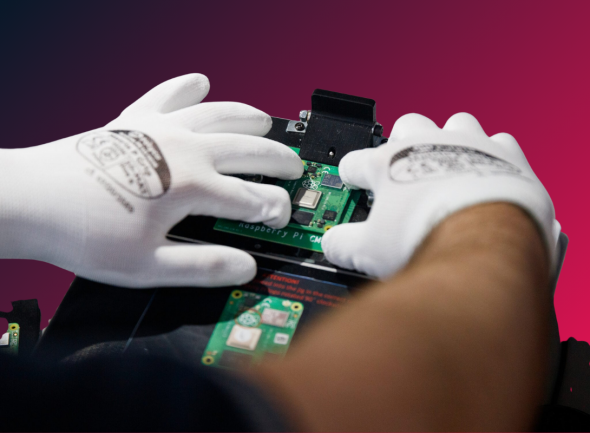
Raspberry Pi manufactures its single-board computers at the Sony UK Technology Centre in Pencoed (South Wales). This local manufacturing setup enables transparent insight into production processes, supports high quality and ethics standards, and reduces the environmental footprint by shortening transport routes and limiting global logistics chains.
About Raspberry Pi’s Sustainability Approach:
- Local manufacturing at the Sony UK Technology Centre in Pencoed, South Wales
- Onshore production reduces complex, energy-intensive global transport chains and lowers the CO₂ footprint
- Zero-waste-to-landfill approach with structured waste and material-flow management on site
- Practical circularity measures, including local reuse initiatives
- Power supply based on 100% renewable electricity, supported by more than 1,700 solar panels
- Biodiversity initiatives, including honeybee colonies cared for by trained employees
- Precious-metal recovery: since 2022, Sony has supported the Royal Mint in recovering gold and other valuable materials from e-waste using a patented room-temperature chemical process
- Local loops: e-waste from Pencoed is delivered to the Royal Mint roughly eight and a half miles away
Another relevant aspect is precious-metal recovery from electronic waste. Since 2022, Sony has supported the Royal Mint in recovering gold and other valuable materials from e-waste using a patented room-temperature chemical process. E-waste from the Pencoed site is processed locally—keeping transport distances short and supporting clearly traceable material loops.
BENEFIT AND COMPETITIVE ADVANTAGE FOR OEMS AND CUSTOMERS
For OEMs and industrial users, this primarily means verifiable evidence and greater transparency on where and how the platform is produced. This improves alignment with procurement and audit requirements, strengthens ESG documentation, and provides a robust basis for customer and stakeholder communication. In tenders and regulated, procurement-driven markets, it can improve positioning—without requiring changes to the established engineering platform.
FOR MORE DETAILLED INFORMATION ON SUSTAINABLE SOLUTIONS BY RASPBERRY PI:
The factory tour makes the manufacturing approach tangible—but it becomes truly relevant in projects when evidence is structured and reusable. Astradis Elektronik translates manufacturing and sustainability information into a format that holds up in technical reviews, procurement processes, and audit situations. This helps connect platform decisions consistently with roadmap planning, series-production requirements, supply-chain resilience, and documentation obligations—on a stable, industrially scalable platform basis.
Contact us now for more information and individual consultation.
FAQ
What is the key takeaway for OEMs?
Local manufacturing and measurable zero-waste and circularity measures strengthen audit and ESG documentation without requiring changes to the established engineering platform.
Does this impact product availability or quality?
The manufacturing organization is designed for transparency and consistent standards. Onshore production can also reduce transport effort and dependencies in global logistics chains—relevant for risk-based procurement.
Where can I find supporting proof points?
For project-specific use, we consolidate the relevant information on manufacturing in Wales, the zero-waste-to-landfill approach, renewable energy measures, and the Royal Mint collaboration for precious-metal recovery—in a format suitable for procurement, audits, or customer communication.